-
-
Singapore
-



Blog Detail
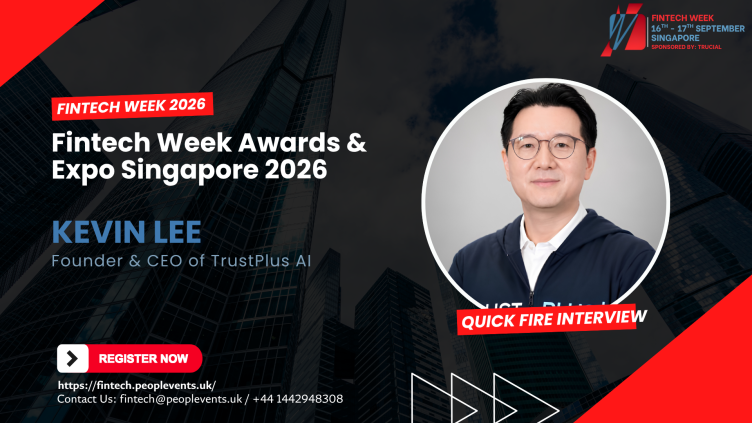
From AI Adoption to AI-Driven Transformation: Kevin K. Lee on the Future of Financial Services
Recent Posts


The financial services industry is entering a defining period of transformation. Artificial intelligence, cloud computing, embedded finance, digital infrastructure and increasingly sophisticated data capabilities are changing not only the products financial institutions offer, but also how financial professionals work and make decisions.
At the FinTech Week Awards & Expo Singapore 2026, industry leaders will come together to examine the technologies, strategies and operating models shaping the next generation of financial services.
Among the voices contributing to this conversation is Kevin K. Lee, Founder of TrustPlus AI, whose career spans more than two decades across financial services and credit risk. His perspective is grounded in a simple but increasingly important principle: true digital transformation is not about adding more technology—it is about fundamentally improving how work gets done.
Ahead of his participation at FinTech Week Awards & Expo Singapore 2026, Kevin shares his views on AI in financial services, credit underwriting, responsible innovation, fintech partnerships, Asia's growth opportunity and the future of digital finance.
1. Your career has spanned innovation, technology, and financial services. What key milestones have most influenced your approach to leadership and driving digital transformation?
After more than two decades in financial services and credit risk, one pattern became impossible for me to ignore: one of the most important decision-making processes in finance was still supported by highly manual and fragmented work.
Credit underwriting requires significant processing of financial statements, company information, research and other largely unstructured data. Yet despite major advances elsewhere in financial services, I saw relatively little fundamental innovation in how this work was performed.
That realization ultimately led me to found TrustPlus AI. It also shaped my leadership philosophy: start with the real business problem, not the technology.
Digital transformation succeeds when deep domain expertise is combined with technology to redesign the workflow—not simply automate individual tasks.
For me, innovation is ultimately about allowing talented professionals to spend less time processing information and more time exercising judgment, managing risk and making better decisions.
2. Financial institutions are increasingly leveraging technologies such as AI, cloud computing, and embedded finance. Which innovations do you believe will have the most transformative impact on the industry over the next five years?
AI will have the most transformative impact, but AI alone will not create transformation.
The pace of AI development is extraordinary. We are moving from AI that assists with individual tasks toward AI that can execute increasingly complex workflows. Cloud infrastructure and embedded finance will provide the rails, but AI will fundamentally change how financial institutions operate.
The critical differentiator will be the combination of AI, domain expertise, workflow integration and governance. Financial institutions cannot simply add an AI tool on top of an existing process and expect transformational results.
Over the next five years, I expect a significant performance gap to emerge between institutions that redesign their workflows around AI and those that remain in prolonged experimentation.
The same will happen at the individual level: professionals who learn to work effectively with AI will operate at a dramatically different level of productivity from those who use it only for basic tasks.
The next competitive advantage in financial services will come from operationalizing AI, not simply adopting it.
3. As a speaker at FinTech Week Awards & Expo Singapore 2026, what are the key insights or real-world experiences you are looking forward to sharing with fellow industry leaders?
The most important message I want to share is that the way professionals work is already changing much faster than many organizations realize.
In our own client deployments, we have seen credit professionals achieve approximately 5–10x higher processing productivity, with underwriting workflows that previously required more than 24 hours being reduced to under three hours.
This changes the conversation around AI.
The question is no longer simply whether AI can perform a particular task accurately. The more strategic question is:
How do we redesign the workflow so AI handles data-intensive processing and analysis, while human professionals focus on judgment, exceptions and critical decisions?
In regulated industries such as financial services, this must also be done with transparency, human oversight and full auditability.
For leadership teams, my message is simple: this is not only a technology initiative. It is an operating-model transformation.
Organizations that move early, learn quickly and redesign their workflows will build a significant and compounding advantage.
4. The fintech ecosystem thrives on collaboration between banks, startups, regulators, and technology providers. What do you believe are the essential ingredients for building successful partnerships that drive meaningful innovation?
Successful innovation starts with trust, aligned incentives and clarity of roles.
Each participant in the financial ecosystem brings something different.
Financial institutions understand their customers, risk appetite and regulatory responsibilities. Startups can bring speed, specialization and disruptive innovation. Technology providers provide the infrastructure to scale. Regulators establish the framework that allows innovation to develop while protecting customers and the integrity of the financial system.
The strongest partnerships occur when these stakeholders do not simply operate alongside one another, but co-create solutions around a clearly defined customer or business problem.
It is also important to establish measurable success criteria early—whether that is improving customer experience, accelerating revenue, reducing operating costs or strengthening risk management.
Innovation becomes sustainable when all parties understand not only what technology can do, but also how it can be deployed responsibly and scaled within the real operating environment of a financial institution.
5. Asia continues to be one of the fastest-growing fintech markets. What opportunities do you see for businesses looking to expand across the region, and how can they navigate its diverse regulatory and market landscapes?
Asia presents an extraordinary opportunity because several transformations are happening simultaneously: rapid digitalization, expansion of cross-border commerce and payments, growing demand for credit, and increasing adoption of AI by financial institutions.
But Asia should never be treated as one market.
It is a collection of highly diverse economies with different regulations, languages, data environments, levels of financial maturity and customer behavior.
The companies that scale successfully will therefore combine global technology with local intelligence.
The core technology and architecture should be scalable across markets, while areas such as data sources, regulatory requirements, language, risk appetite and operating workflows need to be localized.
This is particularly important in financial services, where trust and regulatory compliance are as important as technological capability.
Partnership is also critical. Working closely with local financial institutions, regulators and ecosystem players allows fintech companies to understand market-specific requirements while accelerating adoption.
I see enormous potential in areas such as AI-powered credit assessment, SME financing, cross-border payments and digital financial infrastructure.
The opportunity is not simply to digitize existing financial services, but to use technology to make financial decision-making faster, more inclusive and more scalable across borders.
For companies expanding in Asia, the winning formula will be:
Build a common technology core, localize intelligently, and scale through trusted partnerships.
6. Looking ahead, what advice would you give to entrepreneurs, technology leaders, and financial institutions that are preparing for the next generation of digital finance and global financial innovation?
My advice would be three things: be proactive, stay innovative and remain relentlessly customer-focused.
Do not wait for the AI landscape to stabilize before acting—it will continue to evolve. Organizations need to experiment quickly, learn continuously and build the capability to adapt as the technology advances.
At the same time, innovation should never be driven by technology for technology's sake.
Start with the customer and the business problem. Ask whether the technology can generate revenue faster, improve the customer experience, reduce costs, strengthen risk management or enable professionals to make better decisions.
And finally, think beyond individual AI tools.
The real opportunity is to redesign how the organization works.
I believe the next generation of leading financial institutions will not necessarily be those with the most AI tools. They will be those that successfully combine AI capability, human expertise and responsible governance into a fundamentally better operating model.
That is where the next wave of global financial innovation will come from.
The Future of FinTech Is About Transformation, Not Technology Alone
Kevin K. Lee's perspective highlights a critical shift taking place across the financial services industry. The conversation around AI in fintech is moving beyond experimentation and individual use cases toward a much larger question: how can organizations redesign their operating models around intelligent technology?
From AI-powered credit underwriting and risk management to cross-border payments, SME financing and digital financial infrastructure, the opportunity is significant.
However, technology alone will not determine which organizations succeed.
Tomorrow's leaders will be those who can combine artificial intelligence, financial expertise, human judgment, responsible governance, and customer-centric innovation.
These themes will be central to the conversations at FinTech Week Awards & Expo Singapore 2026, where fintech leaders, financial institutions, technology providers, investors and ecosystem stakeholders will explore the technologies and strategies shaping the future of financial services.
With perspectives from leaders such as Kevin K. Lee, the event provides a platform for the industry to move beyond discussing what AI can do—and focus on what organizations must change to realize its full potential.
Convergence Guide
● Online
✕
● Online
👋 Welcome to the FinTech Week!
🙏 Welcome to FinTech Week, 16–17 September 2026 | Singapore!
Would you like to know details about:
• Sponsorship opportunities
• Available speaking opportunities
• Networking & insights
• Book a quick call
• Agenda request
• Discounts available
Click below to start chatting with us on WhatsApp 👇