-
-
Singapore
-



Blog Detail
Convergence, Continuous Governance, and Measured Innovation at FinTech Week Singapore 2026
Recent Posts


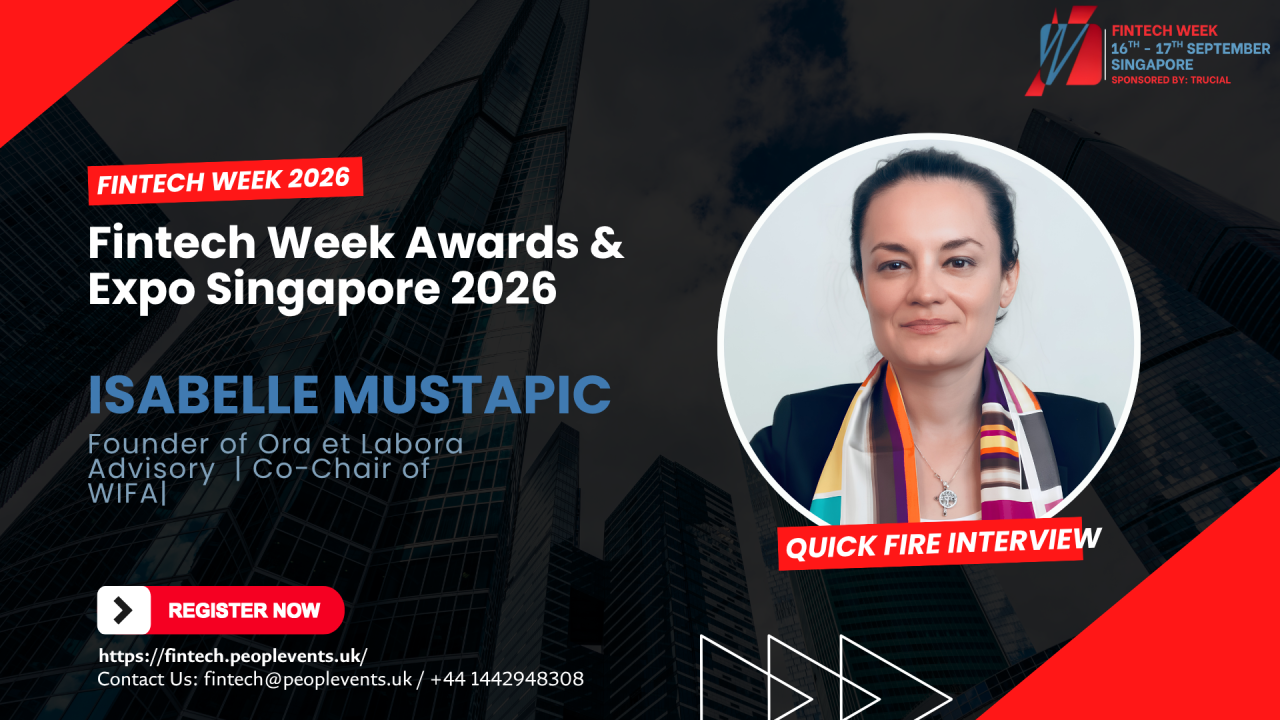
As the global financial ecosystem turns its focus toward the FinTech Week Awards & Expo Singapore 2026 (16th–17th September 2026 at Crowne Plaza Changi Airport), the financial sector is entering a defining era of structural convergence. Banking, digital payments, e-commerce platforms, identity schemes, and emerging tech stacks are merging into a unified operational fabric.
In an exclusive interview, Yiannos Ashiotis—Co-Founder and Group Managing Partner of Pnyx Hill, Board Chairman of Revolut Digital Assets Europe, and Senior Independent Director at StoneX Group Inc. Europe—shares key insights on moving from periodic to continuous risk management, embedding technology into customer-centric platforms, and building resilient financial infrastructure.
1. Professional Journey: Bridging Strategy, Governance, and Technology
With over two decades spent at the intersection of capital markets, regulatory strategy, and corporate governance, Yiannos Ashiotis has guided central banks, tier-one regulators, traditional financial institutions, and fast-growing fintechs through complex transformations:
"Technology has been a constant feature throughout that journey. My focus, however, has never been technology for its own sake. It has been about helping organizations use innovation responsibly to solve real problems, strengthen their operating models and create sustainable value." — Yiannos Ashiotis
Serving across boardrooms as both an advisor and non-executive director, Ashiotis emphasizes that while technology provides the engine for transformation, sound governance remains the foundation upon which long-term enterprise value is created.
2. Key Industry Shifts: The Convergence of Banking, Platforms, and Real-Time Risk
The global financial landscape is undergoing fundamental transformations that will dictate how money and assets move over the next decade:
- Embedded Financial Infrastructure: Banking, lending, and payments are becoming invisible, delivered directly at the moment of need within consumer and merchant platforms.
- Tokenisation & Asset Settlement: Regulated digital assets and tokenisation are re-architecting cross-border collateral management, custody, and settlement rails.
- Shift to Continuous Processes: Compliance, risk management, and financial crime detection are transitioning from periodic audits to real-time, data-driven monitoring.
- Trust as the Ultimate Currency: Technology alone does not guarantee market leadership; institutions must pair modern tech stacks with operational resilience and institutional trust.
3. Measured Innovation: Problem-First Adoption and Controlled Testing
To ensure technology adoption generates true commercial return rather than accumulating technical debt, institutions must maintain rigorous innovation discipline:
- Problem-First Philosophy: Organizations must clearly define the customer or business friction point before adopting new software. Tech deployment without a clear business objective results in expensive experimentation with minimal operational yield.
- Multi-Stakeholder Collaboration from Day One: Risk, compliance, security, and business leads must participate early in the product design phase to embed regulatory controls before launch.
- Targeted Experimentation & Redesigned Workflows: Innovations should be piloted within controlled sandboxes using clear KPIs—such as throughput speed, cost reduction, error rates, and adoption. Real value requires retraining teams, clarifying accountability, and updating legacy workflows.
4. Digital Transformation: Data-Driven Platforms and the Human Touch
Modern data architectures are shifting legacy institutions away from fragmented, product-centric siloes toward unified, data-driven platforms:
- Operational Efficiency & Controls: Automation and AI streamline onboarding, transaction monitoring, and regulatory reporting while providing boards with real-time performance insights.
- Frictionless Customer Experiences: Data-driven systems enable context-aware, personalized financial services delivered with minimal friction.
- Preserving Human Oversight: High-stakes decisions, edge cases, and vulnerable customer groups still require human judgment. Automated decisions must remain fully transparent and explainable.
5. Building Trust, Security, and Operational Resilience
Trust is not built through public relations campaigns; it is earned through day-to-day execution, data privacy, and systemic reliability:
- Secure-by-Design Architecture: Security, access controls, and data privacy must be integrated directly into product code and monitored continuously.
- Testing for Disruption: Rather than assuming system failures will never occur, institutions must regularly test incident response, business continuity, and disaster recovery under severe, realistic stress scenarios.
- Robust AI Governance: As AI models handle critical decisioning, firms require strict data governance, clean datasets, and human-in-the-loop controls to prevent algorithmic bias or systemic failure.
6. Looking Ahead to FinTech Week Singapore 2026
At the FinTech Week Awards & Expo Singapore 2026, Yiannos Ashiotis looks forward to connecting with executives who are actively implementing scalable, compliant digital infrastructure across global corridors.
Singapore provides an exceptional global stage to compare regulatory and technological models across Asia, Europe, and the Middle East. Meaningful industry advancement will ultimately rely on shared interoperability standards, public-private alignment, and a commitment to pairing rapid innovation with responsible governance.
Convergence Guide
● Online
✕
● Online
👋 Welcome to the FinTech Week!
🙏 Welcome to FinTech Week, 16–17 September 2026 | Singapore!
Would you like to know details about:
• Sponsorship opportunities
• Available speaking opportunities
• Networking & insights
• Book a quick call
• Agenda request
• Discounts available
Click below to start chatting with us on WhatsApp 👇