-
-
Singapore
-



Blog Detail
Navigating the Shift in Risk Architecture: AI Governance, Liability, and Operational Impact at FinTech Week Singapore 2026
Recent Posts



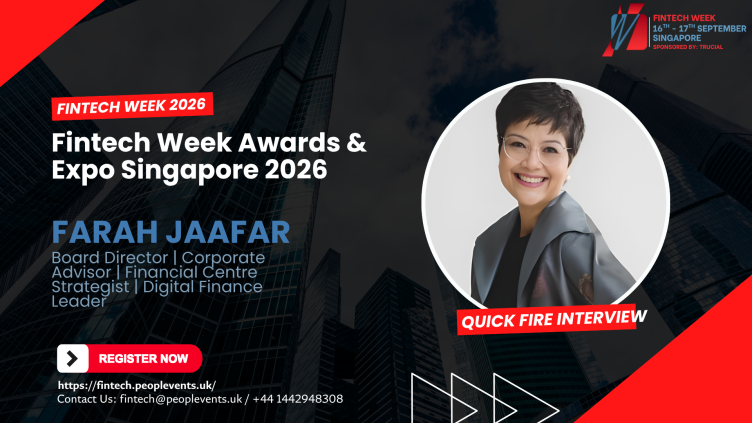
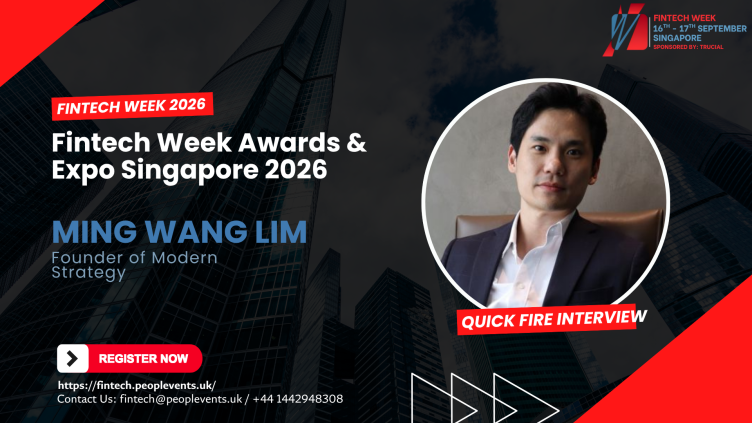
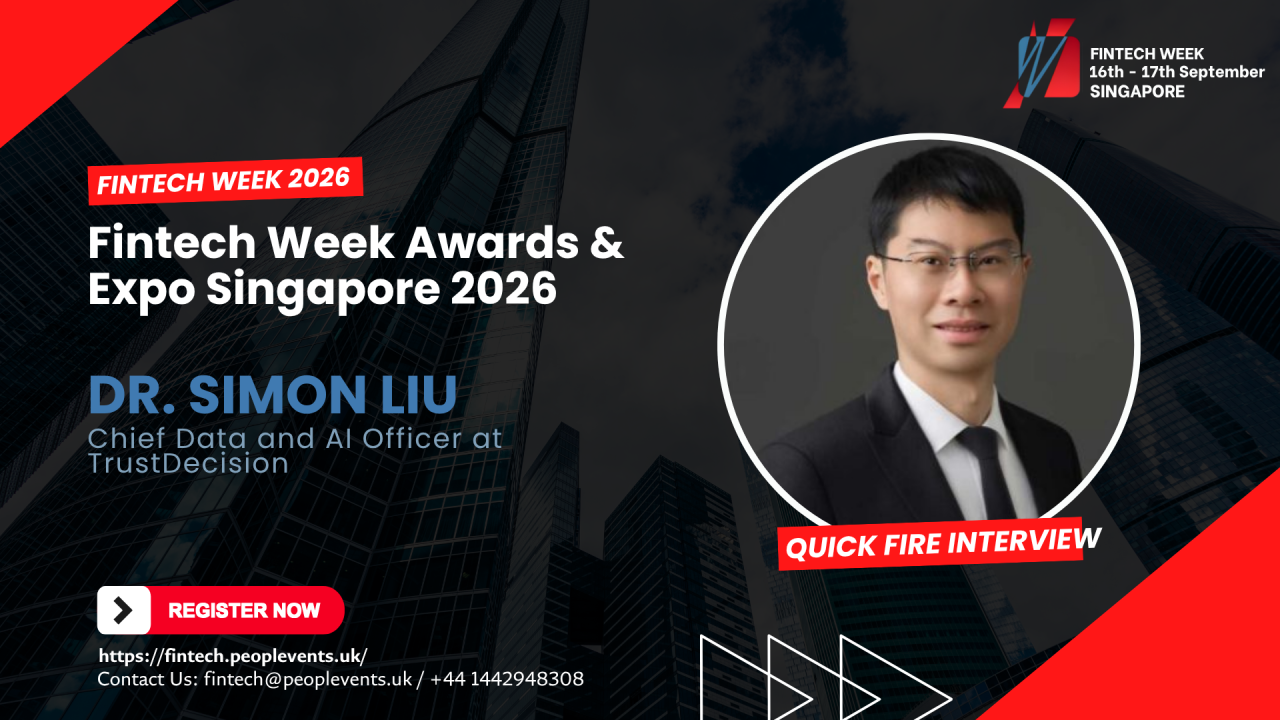
As global executives assemble for the FinTech Week Awards & Expo Singapore 2026 (16–17 September 2026 at Crowne Plaza Changi Airport), the financial sector faces an essential paradigm shift. Operating under the event's core theme, "Finance. Innovation. Future.", artificial intelligence in risk management has moved beyond technical experimentation into a foundational driver of balance sheet performance and regulatory compliance.
Ahead of his session at the summit, Simon Liu —Chief Data & AI Officer at TrustDecision, Adjunct Associate Professor at Nanyang Technological University, and author of AI & Machine Learning for E-commerce Risk Management (Springer Nature)—shares critical insights on liability shifts, real-time risk architectures, measurable technology returns, and the operational governance of autonomous AI systems.
1. Professional Journey: From Financial Crime Analytics to Enterprise AI Leadership
Dr. Liu’s professional trajectory spans quantitative credit modeling, anti-money laundering (AML) analytics, and large-scale digital risk operations across international markets:
- Scotiabank & Financial Crime: Following his Ph.D. at the University of Toronto, Dr. Liu managed credit risk and financial crime analytics at Scotiabank, serving as Director of AML Models and Analytics. During his tenure, he led the development of the institution's first AI-powered model designed specifically to detect human trafficking. The deployment highlighted a vital operational truth: a model can possess exceptional technical precision, but if an investigator cannot interpret its alert reasoning, it yields no practical utility.
- Lazada & High-Velocity E-Commerce: Transitioning to Southeast Asia, he headed data science for risk and security at Lazada, managing complex fraud abuse patterns across massive daily transaction volumes.
- TrustDecision & Industry Thought Leadership: Today at TrustDecision, Dr. Liu oversees fraud, credit, and compliance risk intelligence across more than ten international jurisdictions. His publication with Springer Nature focuses on separating empirically proven risk methodologies from common industry assumptions.
2. Strategic Market Trends: Fraud Liability Transfers and Virtual Banking Benchmarks
Two fundamental shifts are reshaping how institutions prioritize and execute risk management across Asia and global financial markets:
- Institutional Shift of Fraud Loss Liability: Regulatory frameworks are systematically reallocating authorized push payment (APP) and scam losses directly onto financial institutions. Singapore’s Shared Responsibility Framework (implemented in December 2024, with mandatory real-time fraud surveillance duties for banks taking effect in June 2025) reflects similar regulatory mandates established in the United Kingdom and under development across the European Union. Historically, when consumers absorbed fraud losses, risk management functioned as a constrained cost center. Once institutions absorb these losses directly, detection quality becomes an immediate financial metric evaluated at the CFO level.
- The Benchmark Impact of Virtual Banks: Digital-native institutions, such as Thailand's incoming cohort of virtual banks, operate without legacy core systems or decades of accumulated operational exceptions. Their modern architectures set the operational benchmarks against which incumbent institutions are continuously measured.
- Regional Nuance Across Asian Markets: Asia cannot be treated as a single uniform ecosystem. While several regional centers operate real-time decisioning infrastructure at global scale, developing markets remain focused on building foundational data pipelines.
3. Measurable Impact: Grounding Technology Investments in Baseline Metrics
To ensure technology investments deliver quantifiable business outcomes rather than superficial deployment metrics, organizations must establish rigorous pre-implementation baselines:
- Define Pre-Implementation Baselines: Prior to procuring new decisioning platforms, institutions must document existing operational metrics, including credit application processing speeds (at both average and 90th percentile levels), daily case investigation costs, and control deployment timelines. Without baseline data, post-launch evaluations risk measuring effort (such as total models deployed) rather than tangible business outcomes.
- Track Executive Metrics: Organizations should align tech evaluation with core financial metrics, specifically cycle time, total throughput, loss rates, and the critical time gap between detecting a new threat pattern and pushing a live defensive control.
- Proven Commercial Outcomes: In a recent deployment managed by TrustDecision, a financial institution reduced credit approval turnaround times from three days to approximately 300 seconds, compressed new strategy production deployment from five days to ten minutes, and doubled application conversion rates—recovering its investment cost within six months. These outcomes were verifiable precisely because pre-implementation baseline data had been established.
4. Two-Speed Risk Architectures and the Autonomy Governance Ladder
Effective risk systems operate across two distinct operational clocks, which govern the appropriate role and placement of autonomous AI agents:
- The Fast Clock (Deterministic Real-Time Decisioning): Operating within tens of milliseconds at transaction authorization or application scoring, this execution layer must remain deterministic, fully auditable, and strictly controlled. Autonomous AI agents should not make independent execution decisions at this layer.
- The Slow Clock (Agentic Operational Intelligence): Running across minutes, hours, or days, this layer covers complex case investigations, typology mining, and strategy back-testing. Here, AI agents deliver significant value by automatically aggregating device logs, tracing transaction flows, and drafting preliminary reasoning for human analysts. This approach enhances investigative consistency while accelerating overall handling times.
- The Autonomy Governance Ladder: System autonomy is a deliberate governance decision rather than a binary technical toggle. Reversible, high-volume workflows (e.g., placing transactions on temporary review holds) can occupy higher rungs of autonomy. Irreversible, high-impact actions (e.g., declining credit applications or terminating customer accounts) must remain lower on the ladder under direct human oversight.
5. Ecosystem Collaboration: Shared Risk Intelligence and Co-Development
Financial crime operates across interconnected networks, making isolated defense strategies inherently insufficient:
- Shared Signal and Consortium Intelligence: A single mule account viewed within one bank's proprietary dataset often appears unexceptional. When evaluated across multiple institutions, however, organized funds layering and device reuse become visible within seconds. Participation in consortium intelligence and shared risk typologies is essential for comprehensive network defense.
- Transition to Vendor Co-Development: The relationship between technology providers and financial institutions has evolved from traditional procurement models toward joint product co-development. Customizing platforms to address specific regulatory environments across markets requires direct operational collaboration.
- Proactive Regulatory Dialogue: Financial supervisors are evaluating complex agentic systems on short timelines. Institutions that engage regulators early with transparent production data will help establish workable regulatory frameworks.
6. Key Insights for FinTech Week Singapore 2026 Attendees
At FinTech Week Singapore 2026, Dr. Simon Liu will present on deploying agentic AI within enterprise risk management. The session focuses on practical control structures, autonomy placement, auditability, and the challenge of establishing explainability across multi-step agent trajectories.
Beyond structured presentations, Dr. Liu emphasizes the value of candid peer discussions addressing real-world implementation challenges, reviewer governance, and the practicalities of explaining autonomous system trajectories to regulatory bodies.
Convergence Guide
● Online
✕
● Online
👋 Welcome to the FinTech Week!
🙏 Welcome to FinTech Week, 16–17 September 2026 | Singapore!
Would you like to know details about:
• Sponsorship opportunities
• Available speaking opportunities
• Networking & insights
• Book a quick call
• Agenda request
• Discounts available
Click below to start chatting with us on WhatsApp 👇